VPS Provider: How to Choose a Reliable Option in 2026


Introduction
Choosing a VPS provider in 2026 is no longer as simple as comparing CPU cores and monthly pricing. The hosting market is crowded with oversold nodes, vague specifications, recycled hardware, and providers who prioritize marketing over engineering.
This guide breaks down the real factors that matter — privacy, values, renewable energy, performance, networking, support, and infrastructure philosophy — so you can choose a provider that actually delivers reliability in production.
Table of Contents
Privacy & Jurisdiction
Data protection policies
A trustworthy VPS provider must clearly document how customer data is handled, stored, and protected in strict adherence to the General Data Protection Regulation (GDPR) and the complementary Swedish Data Protection Act (Dataskyddsförordningen). Look for providers who publish transparent policies that go beyond mere compliance, emphasizing data minimization and purpose limitation.
A Swedish VPS provider should explicitly state that customer data is never sold to third parties, used for advertising profiling, or subjected to unnecessary scanning. If a provider cannot clearly explain their data handling practices within the framework of Swedish and EU law, they should not be hosting your workloads.
Jurisdiction & legal obligations
Where your server is located determines which laws apply. Sweden offers a highly favorable jurisdiction for data privacy, characterized by strong constitutional protections for confidentiality and a legal system that resists extraterritorial overreach. Unlike jurisdictions subject to broad surveillance mandates (such as the US CLOUD Act), Swedish law requires a specific judicial process for data access requests, ensuring high thresholds for government intervention.
Choosing a VPS provider operating exclusively within Sweden ensures your workloads benefit from these strong data rights, minimizing the risk of unwarranted surveillance or foreign legal coercion. This directly affects the confidentiality of your workloads and aligns with the high trust expectations of Nordic customers.
Physical access control
Security isn’t only digital. A serious VPS provider must operate in data centers with strict physical access control, surveillance, and hardened entry policies. In Sweden — one of Europe’s strongest countries for IT‑infrastructure quality, grid stability, and operational reliability — physical security is treated as a core part of the infrastructure, not an optional certification badge.
Instead of relying on generic ISO labels, Swedish data centers typically implement multi‑layered protection by default: controlled access points, logged entry, compartmentalized server rooms, and 24/7 monitoring. Combined with verifiable energy sourcing — including Green Web Foundation validation and confirmed electricity‑provider documentation — this creates an environment where both the physical integrity and the sustainability profile of your servers can be trusted. If unauthorized individuals can reach the hardware, no software‑level security matters, and Sweden’s infrastructure standards significantly reduce that risk.
Tracking & analytics transparency
Many VPS providers inject analytics, trackers, or third‑party scripts into their control panels. This introduces privacy risks that conflict with the spirit of GDPR and Swedish privacy norms. A serious provider avoids unnecessary tracking and keeps all operational tooling in‑house or self‑hosted within the EU/EEA.
Transparency means clearly listing every script running on management interfaces and ensuring that no user behavior data is shared with external advertising networks. For a Swedish VPS provider, respecting user privacy in the control panel is not just a feature; it is a fundamental legal and ethical obligation.
Renewable Energy & Environmental Values
Modern infrastructure isn’t just evaluated on performance — it’s evaluated on values. In 2026, customers increasingly expect providers to operate on verifiable renewable energy rather than vague sustainability claims. A VPS provider should be able to prove how their electricity is sourced, how their data center is powered, and whether their environmental statements are backed by independent audits. This level of transparency is no longer optional; it’s part of running credible, future‑proof infrastructure.
Verified renewable sourcing
Claims of “carbon neutrality” often rely on cheap, unbundled Renewable Energy Certificates that do not contribute to new renewable capacity. A credible VPS provider goes further by using energy procurement methods that have a measurable, real‑world impact — such as Power Purchase Agreements that directly fund additional renewable generation.
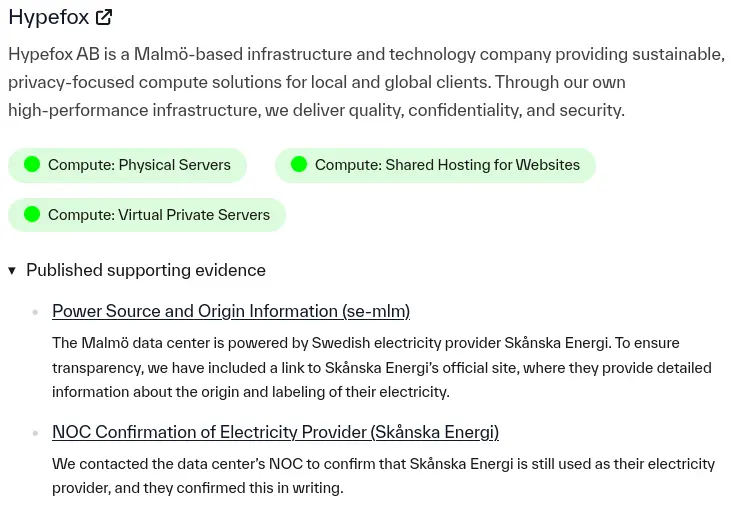
True transparency means publishing granular, verifiable energy data: the exact electricity supplier powering the data center, the real grid mix, and the distinction between solar, wind, hydro, and other sources. The strongest proof comes from independently verifiable documentation, including Green Web Foundation validation and written NOC confirmation of the data center’s electricity provider. This ensures that every environmental claim is backed by real evidence rather than marketing language.
Green Web Foundation checks
The Green Web Foundation maintains a public registry of infrastructure providers running on verifiable renewable energy. If a provider isn’t listed, ask why — transparency is a minimum requirement in 2026. Hypefox, the operator behind Melonslab, is fully listed in the Green Web Foundation directory, confirming that our compute runs on certified renewable energy.
Transparency vs greenwashing
Greenwashing often appears as broad promises like “net‑zero by 2050” without interim targets, evidence, or operational transparency. A credible VPS provider avoids this by focusing on verifiable, immediate impacts — not distant marketing goals. True transparency means publishing real energy data, clearly stating which electricity supplier powers the data center, and providing documentation that can be independently confirmed.
This includes acknowledging the environmental cost of hardware manufacturing, reporting the actual power source and grid mix, and supporting claims with third‑party verification such as Green Web Foundation validation and written NOC confirmation of the data center’s electricity provider.
Hardware Quality & Performance
The hardware stack a VPS provider uses directly determines stability, throughput, and how predictably workloads behave under load. In 2026, many providers rely on generic NVMe‑based setups, mixed hardware generations, or opportunistic component sourcing. This creates inconsistent performance, unpredictable latency, and thermal behavior that varies from node to node — especially under sustained real‑world workloads rather than synthetic benchmarks.
Melonslab takes a fundamentally different approach. Each compute tier defines both CPU and storage performance characteristics, ensuring that I/O throughput, latency, and sustained performance scale consistently with the tier. This eliminates the “lottery effect” common in providers who mix consumer SSDs, different NVMe controllers, or multiple motherboard generations within the same fleet. When the hardware is inconsistent, the performance is inconsistent — and customers feel it immediately in database workloads, CI pipelines, and latency‑sensitive applications.
All systems run on HPE‑validated enterprise hardware with advanced ECC memory and RAID‑protected storage. This creates a clean, deterministic environment where thermal envelopes, firmware behavior, and component interactions are predictable across the entire platform. HPE’s validation process ensures that every component — from memory controllers to PCIe lanes — behaves consistently under 24/7 load, eliminating the silent instability that often comes from consumer‑grade or mixed‑vendor setups.
The result is a compute platform built for long‑term operational stability rather than short‑term marketing claims:
- performance does not degrade as drives heat up
- latency remains stable even under sustained I/O
- firmware behaves consistently across all nodes
- workloads scale predictably with the compute tier
- no “burst‑then‑collapse” NVMe behavior
- no surprises caused by mismatched hardware generations
Where many VPS providers optimize for attractive benchmark numbers, Melonslab optimizes for deterministic, operator‑grade performance — the kind that matters when workloads run for months, not minutes.
Enterprise‑grade HPE platforms
Melonslab runs exclusively on HPE‑validated server hardware, ensuring consistent thermals, stable firmware, and predictable performance across all compute tiers. Unlike many providers who mix consumer‑grade parts with aging enterprise components, HPE platforms are engineered for continuous operation under sustained load. This gives a VPS provider the foundation required for deterministic performance — not burst‑based behavior that collapses under real workloads.
HPE’s server architecture is built around long‑term stability: controlled thermal envelopes, validated component combinations, predictable firmware behavior, and hardware designed to run 24/7 for years without degradation. This eliminates the instability that often comes from heterogeneous hardware fleets, mismatched NVMe controllers, or consumer motherboards with inconsistent power delivery. The result is a compute environment where performance does not fluctuate based on temperature, firmware quirks, or mixed component quality.
For customers, this translates into real operational stability: workloads behave the same today as they will tomorrow, latency remains consistent under load, and the risk of silent hardware faults is dramatically reduced. In a market where many VPS providers rely on opportunistic hardware sourcing, Melonslab’s HPE‑only approach ensures a clean, predictable, and operator‑grade infrastructure built for long‑term reliability rather than short‑term marketing claims.
Advanced ECC memory
All compute tiers use advanced ECC memory modules from HPE, providing multi‑bit error correction, continuous memory scrubbing, and long‑term data integrity. For a serious VPS provider, this is not an optional upgrade — it is the foundation for deterministic, stable compute.
ECC memory eliminates silent corruption, one of the most dangerous failure modes in virtualized environments. Without ECC, bit‑flips caused by electrical noise, thermal variance, or aging DIMMs can propagate into databases, file systems, and long‑running processes without any visible warning. HPE’s validated ECC modules detect and correct these faults in real time, ensuring that workloads behave consistently even under sustained load.
Beyond error correction, HPE’s memory architecture is designed for thermal stability, predictable latency, and firmware‑level consistency across generations. This prevents the jitter, random crashes, and intermittent performance drops that often occur in mixed‑hardware fleets or consumer‑grade setups. For customers, this translates into a compute environment where:
- databases remain stable over months of uptime
- long‑running processes don’t degrade due to memory drift
- virtual machines behave identically across reboots and migrations
- critical workloads maintain integrity even under peak load
In a market where many VPS providers cut costs by mixing memory vendors or using non‑ECC modules, Melonslab’s HPE‑only ECC approach ensures a clean, predictable, operator‑grade infrastructure built for long‑term reliability rather than short‑term savings.
Tier‑linked storage performance
Melonslab does not rely on generic NVMe marketing or burst‑based performance claims. Instead, storage performance is tied directly to the compute tier, ensuring predictable I/O behavior under real workloads. For a serious VPS provider, this approach eliminates the instability that comes from mixed NVMe controllers, consumer‑grade SSDs, and opportunistic hardware sourcing.
Many providers advertise “NVMe storage” as if the label alone guarantees performance, but NVMe is only a protocol — not a quality standard. Consumer NVMe drives often throttle aggressively under sustained load, degrade over time, and rely on SLC‑cache bursts that collapse during real‑world usage. This leads to inconsistent latency, unpredictable throughput, and degraded performance for databases, file systems, and long‑running processes.
By linking storage performance directly to the compute tier, Melonslab ensures that each tier has a defined, measurable, and sustained I/O profile. Higher tiers provide increased throughput, lower latency, and more consistent long‑term performance — not temporary burst speeds that disappear after a few seconds. This design avoids the “benchmark‑friendly but production‑hostile” behavior common in providers who rely on cheap NVMe drives to inflate marketing numbers.
For customers, this architecture delivers true operational stability:
- I/O performance remains consistent over time
- latency does not spike when SLC caches are exhausted
- workloads behave predictably under sustained load
- databases and storage‑heavy applications avoid jitter and throttling
- performance scales cleanly with the compute tier
In a market where many VPS providers hide behind NVMe buzzwords, Melonslab’s tier‑linked storage model provides a clean, deterministic, operator‑grade environment built for real workloads — not synthetic benchmarks.
Summary
Choosing a VPS provider in 2026 requires far more than comparing CPU cores, RAM allocations, or headline pricing. The providers that actually stand out are the ones that can demonstrate real operational integrity: transparent hardware specifications, consistent network performance, verifiable energy sourcing, predictable storage behavior, and support delivered by engineers rather than ticket macros. In a market filled with oversold nodes, mixed hardware generations, and vague “green” claims, the ability to prove how infrastructure is built — and powered — matters more than ever.
A credible provider shows exactly which hardware is used, how performance scales across tiers, how storage behaves under sustained load, and where the data center’s electricity comes from. This includes publishing verifiable energy data, offering third‑party confirmations such as Green Web Foundation validation, and maintaining a clean, deterministic hardware stack that behaves predictably over months of uptime. Stability, transparency, and long‑term reliability are no longer optional — they are the baseline for any serious workload.
If you want a provider that meets these standards with operator‑grade infrastructure, verifiable energy sourcing, and a clean, predictable compute environment, Melonslab delivers a platform built for real workloads rather than marketing benchmarks.